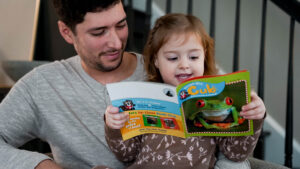
If you’ve ever tried to read a full picture book to a squirming three-year-old and made it four pages before they wandered off to reorganize their stuffed animals, you already know: literacy doesn’t happen on a schedule at this age. And that’s fine. Preschoolers build reading skills in the in-between moments as much as story time, in a rhyme at breakfast, a made-up word in the car, a question about why owls have big eyes.
At Ranger Rick, we’ve spent over 59 years alongside families discovering how stories, photos, comics, and even a few silly animal jokes can open the door to learning. Here are seven of our favorite ways to nurture that love of reading, built for however your week actually looks.
1. Storytime in Small Bites
Long sit-down sessions aren’t the only way to read. Preschoolers thrive on short bursts of stories scattered throughout the day.
How to try it:
- Read a silly rhyme while your child eats breakfast.
- Share a comic strip or magazine page in the car line or bus stop.
- Keep a “bedtime basket” with three short books or magazines for your child to choose from before bed.
Adjustments for your schedule:
- Busy mornings? Read at snack time or bath time instead.
- Multiple kids? Let each child choose one short piece (a joke, a poem, or a single page). It keeps things moving without losing anyone’s attention.
Ranger Rick Tip: Animal fact blurbs or one-page comics from our magazines are perfect for bite-sized story time. They give you a finished moment without pressure to read a whole book.
2. Alphabet Adventures
Letters are everywhere once you start looking. Turning them into a game makes learning feel like discovery.
How to try it:
- On a walk, find letter shapes in nature: a branch shaped like a “Y,” a rock shaped like an “O.”
- At the grocery store, pick one “letter of the day” and spot it on signs, labels, or packaging.
- Write letters on sticky notes and place them around the house for your child to “find.”
Adjustments for your situation:
- In the car? Play “I spy a letter” with nature, landmarks, and road signs.
- At home? Use magnetic letters on the fridge for a quick match-the-letter game while cooking.
Ranger Rick Tip: Flip through a Ranger Rick magazine and ask your child to find every “S” (or other letter) on one page. Then see if they can find an animal whose name starts with that letter.
3. Play With Sounds
Playing with sounds is one of the best ways to build phonemic awareness: the skill of hearing the parts of words. Preschoolers who know nursery rhymes and play rhyming games develop stronger phonological skills, the same skills that predict how easily a child learns to read later on. Translation: the silly rhymes at breakfast are doing real work. And the sillier, the better.
How to try it:
- Make rhyming pairs together (“cat-hat,” “dog-log”), then invent funny ones (“tree-glee,” “snack-quack”).
- Clap out syllables in family names or favorite foods. “Piz-za” gets two claps; “spa-ghet-ti” gets three.
- Swap the first sound of a word for something silly: “Let’s wear our zocks instead of socks.”
Adjustments for your situation:
- On a walk? Clap syllables as you name things you pass: “side-walk,” “stop-sign.”
- At bedtime? Do a “rhyme race” where your child comes up with as many rhyming words as they can before lights out.
Ranger Rick Tip: Try this with animal names. Say “shark” and see how many rhymes your child can come up with (“bark, lark, park”).
4. Tell Your Own Stories
Preschoolers are natural storytellers. Sometimes you just need to give them a springboard.
How to try it:
- After reading, ask: “What do you think happened next?”
- Use toys or stuffed animals to act out a new adventure.
- Look at a photo (from a book or magazine) and ask, “What do you think this animal was doing right before this picture was taken?”
Adjustments for your situation:
- Short on time? Tell a “two-sentence story” in the car or while waiting in line. Your child can add the ending.
- Need calm? Try “story dictation.” Ask your child to tell you a story while you write it down, then read it back.
Ranger Rick Tip: Flip to a wildlife photo and invite your child to narrate what’s happening. “Why is that penguin looking up? What is it thinking?”
5. Reading Through Play
Words don’t have to stay on the page. Kids learn best when they move and imagine.
How to try it:
- After reading about animals, act them out together. Crawl like turtles, jump like frogs, or stretch like giraffes.
- Turn a story into a mini play. Your child can assign roles and props.
- Using LEGO or other building blocks, create “settings” that match a story (a castle, a forest, or even a raccoon den).
Adjustments for your situation:
- Need indoor energy burners? Use animal moves as a literacy-plus-movement game.
- Low-energy days? Use finger puppets or toys instead of big movements.
Ranger Rick Tip: Many Ranger Rick magazine stories feature animals in action. Use those as inspiration for playtime reenactments.
6. Mix Words with Art
Drawing and writing go hand in hand. Preschoolers often tell stories better with pictures first, and you can add words together.
How to try it:
- Fold paper into a “book” and let your child illustrate a story. Together, add simple words underneath.
- After story time, ask your child to draw their favorite character or scene.
- Create a “word wall” of their drawings with labels for animals, colors, or feelings.
Adjustments for your situation:
- No time for a big art project? Keep a small notepad nearby and draw one picture with one word before bed.
- On the go? Use a pocket notebook for “story doodles” in the car or at a restaurant.
Ranger Rick Tip: Encourage your child to copy an animal photo from the magazine and label it with a simple word like “big,” “fast,” or “funny.”
7. Celebrate Curiosity
Every “why” is a chance to build language and connection.
How to try it:
- Answer questions with a story, not just facts. If your child asks “Why do owls have big eyes?” invite them to imagine being an owl in the dark.
- Keep a “question journal.” Write down their questions during the day, then read them back at night.
- Use books, magazines, or photos to fuel their curiosity and let them describe what they notice.
Adjustments for your situation:
- Busy day? Jot down just one question and revisit it at bedtime.
- Limited access to books? Encourage oral storytelling: make up a shared story about the question and tell it together.
Ranger Rick Tip: When your child asks about animals, look at a Ranger Rick photo together. Ask: “What do you notice about its eyes, wings, or fur?” Every observation is a literacy-building moment.
You don’t need perfect reading sessions to make a difference. What matters is joy. The kind that shows up in giggles, rhymes, and curious questions. Those moments are where literacy takes root.
Ready for more? 25 reading games that turn early practice into play keeps the momentum going once your preschooler’s ready for a little more structure, and our beginner-reader book picks for ages 4 and up are stocked with exactly the kind of silly-animal-fact content this list keeps coming back to.
Since 1967, Ranger Rick has watched playful literacy turn into a lifelong love of wildlife and reading alike. Find the right magazine for your reader and bring a little more of that curiosity home every month.