

Giant Manta Rays
By Kathy KrankingSay “hello” to a real ocean giant!
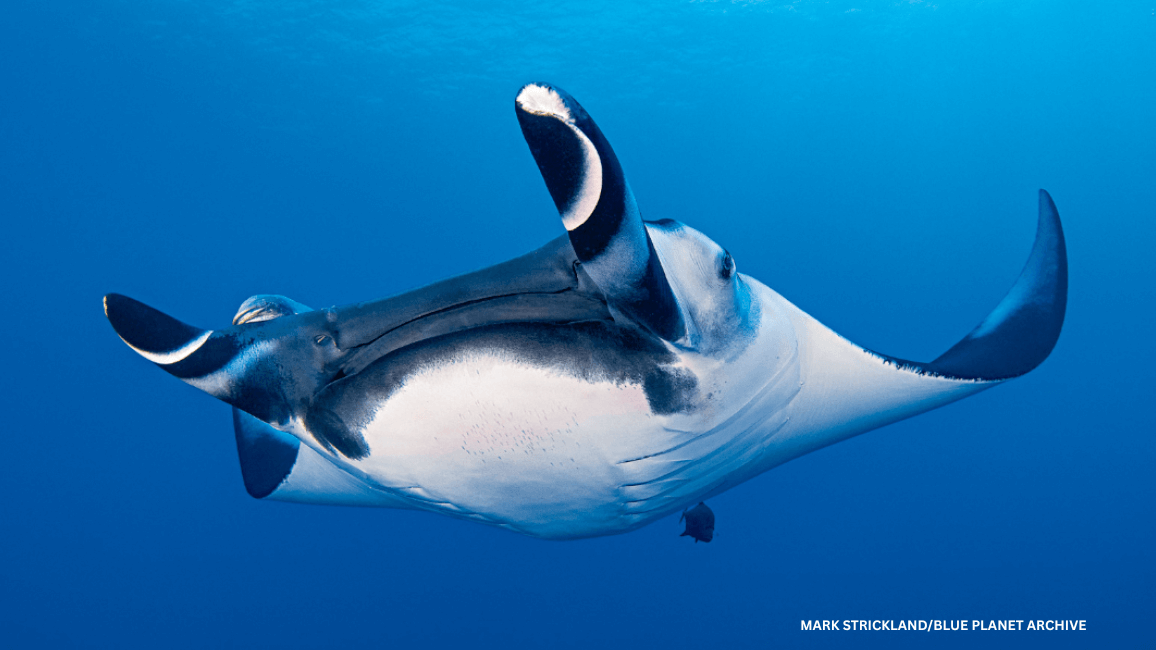
Meet the amazing giant manta ray. It has a body shaped like a kite. It has fins that flap like wings. And when it swims, it looks as if it were flying gracefully through the water.
But what exactly is a ray? It’s a fish. Rays are close cousins of sharks, and there are more than 600 species of them. But the giant manta ray lives up to its name: It’s the biggest of all. Keep reading for more about this supersized ray.

BIG AND BEAUTIFUL
Just how giant is a giant manta? It’s so big that three grownups could lie head-to toe across its flat back with room to spare. And it weighs more than a car!
Giant manta rays live in all the world’s warm and semi-warm oceans, from shallow coastal areas to deep ocean depths. They can be recognized not only by their huge size but also by their striking looks: black backs with white shoulder patches. The shoulder patches outline a black T on the top of a manta’s head. Its belly is white with black spots or splotches. And just as no two people have the same fingerprints, every giant manta has a unique belly pattern. Scientists can use these marks to identify different giant mantas.

MANTA MUNCHIES
On each side of a manta’s mouth is a special part called a cephalic (seh-FAL-ik) fin. The manta uses its cephalic fins when it’s feeding. As you might expect, a giant manta chows down on huge amounts of food—about 60 pounds per day. But as you might not expect, a lot of the food it eats is very small. Giant mantas eat tiny animals called zooplankton. But they’ll also eat bigger animals such as small fish.
When feeding, mantas use their cephalic fins to funnel food and water into their large mouths. Special parts inside a manta’s mouth strain the food from the water. Then the manta swallows the food, while the water goes back out through slits on its underside. When mantas are not feeding, they keep their cephalic fins rolled up.
BABY GIANTS
Some kinds of fish lay hundreds of eggs. Others give birth to dozens and dozens of babies. But a giant manta has only one baby at a time. 18 The baby, called a pup, grows inside its mom’s body, getting nourishment from a yolk sac. After about 13 months, the baby is born.
A giant manta pup looks like a mini version of an adult manta. It’s only about 4 feet wide from wingtip to wingtip. And from the moment it’s born, it’s ready to be on its own. It flaps its little wings and off it swims.

PROTECTING MANTAS
Unfortunately, giant mantas are swimming into an uncertain future. For a number of different reasons, they are in danger of becoming extinct. The biggest problem they face is overfishing. People catch mantas to sell their body parts. But mantas also accidentally get caught in nets meant to catch different kinds of fish. Other threats include pollution and climate change.
Now that the number of giant manta rays has gotten lower, it’s hard for the mantas to build their population back up. Female manta rays usually don’t have babies until they are 10 or more years old. And after that, they each give birth to only one baby every two to five years.
But the hopeful news is that people are working to help giant mantas. One way is by making protected areas in some of the places where the mantas feed and mate. Another is by educating people about the threats mantas face. The hope is that these amazing creatures will keep flapping their way through the ocean for a long time to come.


