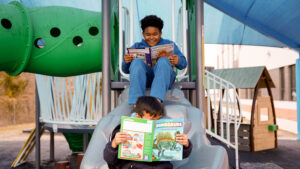
Reading can be quiet time curled up with a book, but it can also be giggly, wiggly, and full of movement. When words meet play, something wonderful happens: kids remember what they learn, and they ask for more.
Through years of making engaging magazines for kids, we’ve learned that the most effective early literacy skill building often looks like play.
These 25 reading games combine skill development with curiosity, creativity, and laughter. Most need only simple materials you might already have, and many take just 5-10 minutes.
The games below address 5 core areas of literacy in ways that feel like discovery, not drills:
- Phonemic awareness (hearing sounds in words)
- Phonics (connecting letters to sounds)
- Fluency (reading smoothly)
- Vocabulary (understanding words)
- Comprehension (grasping meaning)
We’ve organized our games by the primary skill they build, though many games strengthen multiple areas at once. Choose based on where your child is right now and what sparks their interest.
25 games for pre-readers and emerging readers (Ages 3-6)
1. Animal Sound Match
Core Skills: Vocabulary, phonemic awareness, word-sound association
What You Need: Animal photos (from magazines, printed from RangerRick.org, or even stuffed animals), index cards
Time: 5-10 minutes
Cut out or gather animal pictures and write each name on a card. Your child matches the word to the picture while making the animal’s sound.
When children see the picture, say the word, hear the sound, and move the cards, they’re creating multiple memory pathways at once. This multi-sensory connection helps the word stick in ways that seeing or hearing alone often doesn’t achieve.
Simple variation: One person makes the sound, the other finds the matching card and tries to read or recognize the word.
2. Alphabet Nature Hunt
Core Skills: Letter recognition, beginning sounds, observation, locus of control
What You Need: Outdoors or any room in your home, paper and pencil (optional)
Time: 10-15 minutes
Pick a letter and look for something that starts with that sound. “B” for bird, “C” for cloud, “R” for rock. Record discoveries by drawing or writing them. For pre-writers, you can jot down their finds.
Connecting abstract letters to concrete objects in the real world helps children understand that letters represent sounds, which is foundational for reading.
Indoor adaptation: Search the kitchen or living room instead. “P” for plate, “S” for spoon, “T” for table.
3. Alphabet Soup
Core Skills: Letter recognition, letter formation, early spelling
What You Need: Foam or magnetic letters, a bowl or bin
Time: 5-10 minutes
Fill a bowl with letters. Kids scoop out a few and try to name them, match them to objects that start with that letter, or eventually spell simple words. For the youngest learners, just naming and sorting by color works perfectly.
Tactile letter manipulation creates motor memory alongside visual recognition. When kids physically handle letters, they engage different parts of the brain than they do with flashcards, making the learning more memorable.
4. Letter Jump
Core Skills: Letter recognition, phonics, gross motor development
What You Need: Chalk or painter’s tape, space to move
Time: 5-10 minutes
Write large letters on the ground or floor. Call out a sound and have your child jump to the matching letter, then say a word that starts with it. This combines physical activity with phonics practice.
5. Sound Safari
Core Skills: Beginning sounds, phonemic awareness, listening skills
What You Need: Your voice and your surroundings
Time: 5-10 minutes
Call out a letter sound and hunt for something nearby that starts with it. “Find something that starts with the mmmmmm sound of M.” This works anywhere: the park, the grocery store, or the waiting room.
Practicing isolated sounds (phonemes) is foundational for reading success. When children can hear and identify individual sounds in words, they’re building the skills they need to decode and sound out new words later.
Extension: Once your child finds an object, have them think of other words that start with the same sound.
Further Reading: Literacy Activities for Preschoolers
Games for early readers (Ages 5-8)
6. Reading Hopscotch
Core Skills: Sight word fluency, reading fluency, coordination
What You Need: Chalk or tape, sight word list
Time: 10-15 minutes
Draw a hopscotch grid and write a sight word in each square. Kids hop and read the word they land on. The combination of movement and repetition builds reading fluency (the ability to read smoothly and quickly) without the boredom of flashcards.
Variation: Use vocabulary words from a book you’re reading together, or rhyming words for phonics practice.
Outdoor play bonus: This game is perfect for unplugging from screens and playing outside. A driveway, sidewalk, or even a parking lot or tennis court works beautifully. The fresh air and space to move make learning feel like an adventure.
7. Word Fishing
Core Skills: Word recognition, reading fluency, fine motor skills
What You Need: Paper, scissors, paperclips, stick or ruler, string, small magnet
Time: 10-15 minutes
Cut fish shapes and write a word on each. Attach a paperclip to each fish. Create a “fishing rod” with a stick, string, and magnet. Kids catch and read each fish to keep it.
The game element provides immediate positive feedback (catching a fish) for reading effort, which builds motivation and confidence.
Challenge option: Group catches by word families (cat, hat, bat) or count syllables in each word caught.
8. Read and Seek
Core Skills: Word recognition, visual scanning, reading comprehension, locus of control
What You Need: Index cards or sticky notes, pen
Time: 10-20 minutes
Hide word cards or short sentences around a room. Give your child clues to find them, and they read each one aloud when discovered. You can make this more complex with simple riddles or two-step directions.
Not only does the treasure hunt format maintain engagement, but kids also build confidence that they can solve problems on their own.
Group variation: Color-code cards for teams to race, or hide cards that form one complete sentence when found in order.
9. Word-Building Towers
Core Skills: Spelling, phonics, word families, pattern recognition
What You Need: Building blocks, marker
Time: 10-15 minutes
Write letters on blocks and stack them to create words. Read each word aloud before knocking down the tower. This works particularly well for word families (cat, hat, mat, sat).
The hands-on manipulation combined with immediate visual feedback helps children understand how changing one letter changes the word, a key phonics concept.
Extension: Challenge your child to build the tallest tower using only real words, or race to see who can build a word family tower fastest.
10. Silly Sentence Shuffle
Core Skills: Sentence structure, parts of speech, creative thinking, grammar
What You Need: Index cards in 3-4 different colors, markers
Time: 10-15 minutes
Write nouns on one color, verbs on another, and adjectives on a third. Draw one of each to form ridiculous sentences: “The sleepy elephant danced,” “A purple dog sang.” Read them aloud and illustrate your favorites.
This game makes grammar tangible and funny, which means kids remember it.
Extension: Add adverbs (quickly, slowly) or setting words (in the tree, under the moon) for older kids.
Games for developing readers (Ages 6-10)
11. Story Stroll
Core Skills: Sequencing, comprehension, prediction, fluency
What You Need: Paper, markers, tape, hallway or outdoor path
Time: 15-20 minutes to create, 5-10 to read
Write one sentence of a story per page. Tape pages along a hallway, sidewalk, or nature path. Walk and read each segment until “The End.” Kids can illustrate each page for an extra creative element.
Co-creation option: Write the story together, with your child dictating or writing alternate pages.
12. Reading Scavenger Hunt
Core Skills: Print awareness, word recognition, real-world reading application, reading for information
What You Need: Printed list of clues, everyday printed materials
Time: 15-20 minutes
Create clues like “Find a word with three letters,” “Find something with an exclamation point,” or “Find a title with an animal name.” Kids search books, magazines, food packaging, or signs to complete the list.
This builds print awareness (understanding that print carries meaning and appears everywhere) while showing kids that reading is useful in daily life, not just in books.
At-home adaptation: Limit the hunt to junk mail, product packaging, or a single magazine to make it manageable.
13. Storytelling Dice
Core Skills: Oral language, story structure, vocabulary, sequencing, creativity
What You Need: Small boxes or blocks, markers or stickers
Time: 10-20 minutes
Create dice by drawing simple images on cube sides: animals, settings, emotions, actions. Roll 2-3 dice and make up a story using all the images shown. Pre-readers can tell the story while you transcribe it.
When children understand how stories work (beginning, middle, end, characters, problems, solutions), they bring that understanding to everything they read.
Extension: Roll dice to start a story, then pass it to the next person to continue, building collaborative storytelling skills.
14. Reading Relay
Core Skills: Reading fluency, teamwork, motivation
What You Need: Sentence strips or cards, open space
Time: 10-15 minutes
Place sentence strips at one end of a room or yard. Kids take turns racing (or hopping, crawling, skipping) to grab one, read it aloud, then tag the next player. The movement breaks add energy to reading practice.
Solo variation: Set a timer and see how many sentences can be read before time runs out, or create an obstacle course between the child and the sentences.
15. Sentence Scramble
Core Skills: Syntax, word order, sentence structure, comprehension
What You Need: Paper, scissors, sentences from books or original
Time: 10-15 minutes
Write a sentence and cut apart each word. Mix them up and have your child reassemble them in the correct order. Read the final sentence aloud to verify it makes sense.
Manipulating word order helps children understand syntax (how word position affects meaning) and strengthens comprehension skills.
Challenge level: Add punctuation marks as separate pieces, or use longer, more complex sentences for older readers.
16. Picture Caption Contest
Core Skills: Writing, descriptive language, vocabulary, humor, creativity
What You Need: Funny animal photos (from Ranger Rick magazines work perfectly), paper, pencils
Time: 10-15 minutes
Show a humorous wildlife photo and have kids write or dictate a caption. Share all captions and vote for favorites, or just enjoy reading them aloud together.
Writing for an audience (even if it’s just family) and with a clear purpose (being funny) motivates kids to choose words carefully and revise their work.
Confidence builder: There are no wrong answers here, which makes this perfect for reluctant writers.
17. Reading Bingo
Core Skills: Reading variety, motivation, goal-setting, exposure to genres
What You Need: Printed Bingo card, books
Time: Ongoing over days or weeks
Create a Bingo card with varied reading challenges: “Read under a blanket fort,” “Read a comic,” “Read outside,” “Read to a pet,” “Read something funny.” Mark boxes as completed.
This makes reading variety feel like a fun challenge and helps kids discover new genres and settings they might not have otherwise tried.
Family variation: Make a family Bingo card where everyone participates, or offer small celebrations (not bribes) for completed rows.
Quick games for any skill level
18. Rhyme Race
Core Skills: Phonemic awareness, listening, quick thinking
What You Need: Nothing but your voice
Time: 3-5 minutes
Say a word and see how many rhymes your child can generate before a timer runs out. Start with easy words (cat, tree) and progress to harder ones (orange is famously difficult to rhyme).
Rhyming strengthens phonological awareness, and that directly supports decoding skills when children begin reading independently.
Animal twist: Use animal names for nature-loving kids: bat, frog, shark, snake.
19. Animal Action Words
Core Skills: Vocabulary, verb recognition, movement, observation
What You Need: Small paper slips, pen
Time: 5-10 minutes
Write action verbs on slips of paper. Kids draw one, read it (or have it read to them), and act it out. This combines movement with vocabulary building.
Acting out words creates a physical memory that helps cement vocabulary more effectively than definitions alone.
Nature connection: Include wildlife-specific verbs like pounce, flutter, slither, burrow, or soar.
20. Guess My Word
Core Skills: Vocabulary, comprehension, critical thinking, listening
What You Need: Your imagination
Time: 5-10 minutes
Give clues about a mystery word: “It starts with B. It lives in a forest. It loves honey. It hibernates in winter.” Kids guess and spell the word aloud when they solve it.
This game builds vocabulary, listening comprehension, and reasoning skills (figuring things out from clues) all at once. And, it allows you to effortlessly adjust difficulty to your child’s level.
Turn-taking: Let your child give you clues, which helps them practice explaining what words mean and builds vocabulary even more effectively.
21. Picture-to-Word Match
Core Skills: Vocabulary, sight word recognition, comprehension
What You Need: Magazine photos or printed images, index cards
Time: 5-10 minutes
Cut out interesting pictures and write matching words on cards. Kids read and pair the correct word with each image. Use wildlife photos for rich vocabulary like “camouflage,” “migration,” or “adaptation.”
Level up: Use phrases instead of single words, or include unusual vocabulary from a book you’re reading together.
22. Magazine Mash-Up
Core Skills: Vocabulary, sequencing, creative writing, comprehension
What You Need: Old magazines, scissors, glue, paper
Time: 15-30 minutes
Cut out pictures and words from magazines (Ranger Rick back issues work great). Arrange them into a story, poem, or wild word collage. Glue them down and “read” the creation together.
This combines visual literacy, creativity, and word recognition while producing a physical piece of art that kids feel proud of.
Simplified version: Match one word to one picture for beginning readers.
23. Story Stones
Core Skills: Oral storytelling, sequencing, vocabulary, narrative structure
What You Need: Smooth stones or wooden discs, paint or markers
Time: 10-15 minutes (after initial creation)
Paint or draw simple images on stones: animals, weather, objects, emotions. Kids draw 3-5 stones and tell a story incorporating each image. You can write it down afterward for reading practice.
Oral storytelling builds the narrative structure skills that directly translate to reading comprehension, and the random element sparks creativity.
Pre-reader perfect: This requires zero reading ability but builds critical pre-literacy skills.
24. Reading Yoga
Core Skills: Vocabulary, comprehension, body awareness, following directions
What You Need: Word cards or your voice
Time: 5-10 minutes
Write action phrases on cards: “stretch like a tall tree,” “curl like a sleeping bear,” “balance like a flamingo.” Kids draw a card, read it, and act it out. This combines literacy with movement and body awareness.
The movement component provides a brain break while still practicing reading, and the novelty keeps engagement high.
Calm-down tool: This works beautifully as a transition activity or when energy levels need gentle redirection.
25. Word Garden
Core Skills: Sight word recognition, sentence formation, repetition without boredom
What You Need: Paper cutouts (flowers, or seasonal shapes like pumpkins or butterflies), markers, sandbox or yard
Time: 10-15 minutes
Cut shapes and write one sight word on each. “Plant” them in a sensory bin, sandbox, or yard. Kids pick each shape, read the word aloud, and use it in a sentence.
Seasonal variation: Change the shapes with the seasons to keep it feeling new. Paper flowers work beautifully in spring and summer. In fall, try pumpkin shapes. In winter, try hearts (for Valentine’s Day) or snowflakes. Come spring again, butterflies or tulips bring fresh energy. The shape changes, but the learning stays playful.
Choosing the right games for your child
With 25 options, you might be wondering where to start. Here’s how to decide:
Match the skill to the need: If your child is working on sounding out words, focus on phonemic awareness games (Rhyme Race, Sound Safari, Alphabet Nature Hunt). If they read word-by-word without flow, try fluency games (Reading Hopscotch, Word Fishing, Reading Relay).
Honor the energy level: Tired after school? Try quiet games like Story Stones or Picture-to-Word Match. Need to burn energy? Go for Reading Hopscotch, Letter Jump, or Reading Relay.
Follow the interest: A child obsessed with animals will engage more deeply with Animal Sound Match or wildlife-focused vocabulary building. A builder might love Word-Building Towers.
Keep it short: Five to ten minutes of engaged play beats 30 minutes of struggle. You can always play again tomorrow.
When your child needs an invitation to play
Sometimes kids need a gentle invitation rather than a directive. A few approaches that help:
Let them choose the game. When kids get to decide which game to play, they engage more deeply, even if they pick the same game five days in a row. That choice builds their locus of control, their confidence that they have power over their own learning.
Play alongside them, not at them. When you’re having fun and not testing them, they’re more likely to relax and participate authentically.
Keep it light. If it feels like homework, rebrand it. “Want to go on a sound safari?” sounds very different from “Let’s practice your phonics.”
Make it genuinely optional, but be consistent in offering. Sometimes offering a real choice between a reading game and another activity paradoxically increases willingness. Kids sense when “choice” is really disguised obligation. If you offer choices, be prepared that eventually they may take you up on the alternative option, and that’s okay.
Celebrate the moments of engagement. Three minutes of engaged play teaches more than 20 minutes of resistance. Notice the participation and curiosity, not just the performance.
Ready to explore more early literacy-building activities?
Discover printable activity pages and wildlife stories that turn reading practice into adventure.