

Welcome to Reindeer Valley
By Anne Cissel; Photos by Morgan HeimJoin a group of scientists on a big adventure studying the smallest reindeer in the world.
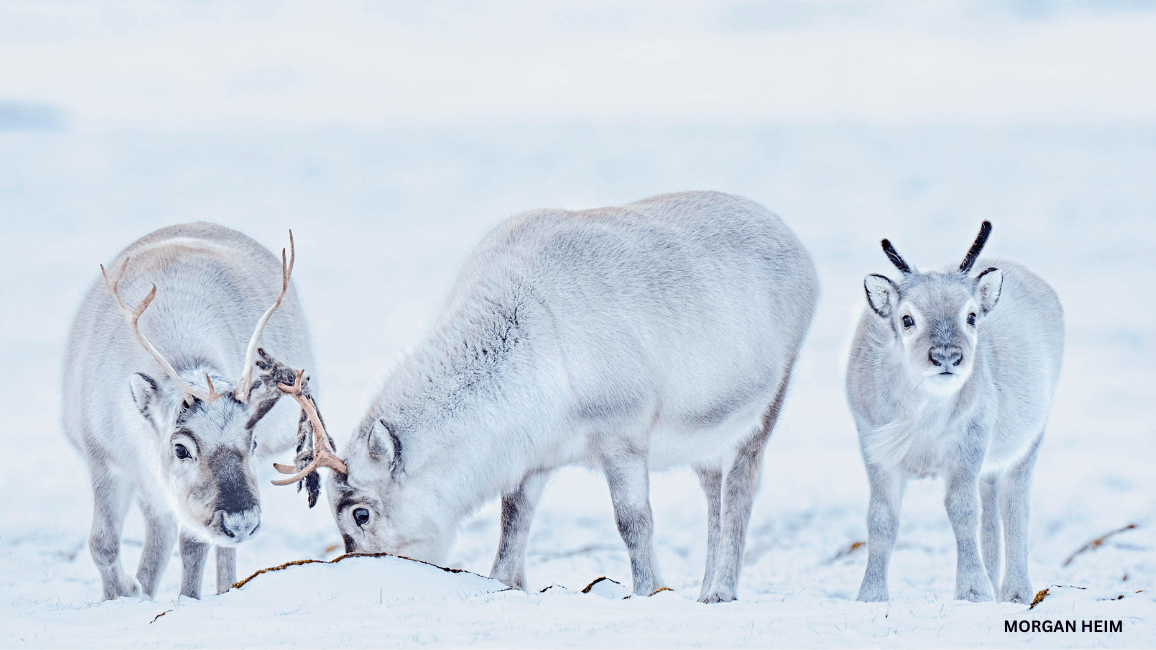
Not far from the North Pole sits an icy, snowy cluster of islands. It’s called Svalbard, and it’s very COLD! But for the fuzzy white creatures you see here, it’s home, sweet home. They are Svalbard reindeer, the smallest kind of reindeer. Adults are only about as tall as a 4-year-old child.
For thousands of years, Svalbard reindeer never saw a single human. Then, in the early 1900s, people came and mined the land for coal. People hunted the reindeer until there weren’t many left. But recently, Svalbard reindeer have made a comeback. Let’s follow some scientists—and their dog—on a journey to the heart of Svalbard to find out how!

DANGEROUS JOURNEY
Studying Svalbard reindeer isn’t easy. On a recent research trip, scientists had to brave wind and ice, hiking three days—25 miles—to reach a place called Reindalen, which translates loosely to “Reindeer Valley.” Their backpacks weighed over 70 pounds each! And even though it was summer, the temperature never got much above 40°F.

Weather wasn’t the only thing to worry about on their journey. Polar bears sometimes show up when people visit the area. That is one reason the scientists brought a dog along on their adventure. Thando kept a constant lookout for bears, so the scientists could do their work. Earlier in Thando’s life, she was smacked by a polar bear! Incredibly, she was unharmed. Tough pup!

RESEARCH BEGINS
Once the scientists reached the valley, they set up camp in a tiny hut. Then the science began. They used an antenna to locate reindeer that had been fitted with radio collars on an earlier visit. The scientists often had to hike for hours to find a signal sent by the collars. They also searched on the ground for old antlers. Old antlers are greenish and break easily. The scientists sent some of the oldest antlers they found to a lab. There, by studying the antlers, scientists can find out things about the environment these reindeer lived in years ago.

BUILT FOR THE COLD
Svalbard reindeer may be small, but they’re tough. Their bodies are made to handle freezing temperatures. With the longest coats of any reindeer, they stay snug. And see the plump male deer (below)? His body fat helps him survive the winter, when there is not much to eat. He doesn’t let off as much heat as larger reindeer because of his short legs and smaller body. Also, he doesn’t migrate—or move around much at all. That means his energy needs are low. But when he does eat, he is very picky!

A CLOSE WATCH
As soon as a reindeer finished nibbling on a plant, the scientists would rush over to examine which bits were devoured. These animals are very good at knowing which parts of plants provide the most energy. For example, they eat only the bloom of a plant, because that’s the most nutritious part.
But that’s not all the scientists examined. When a reindeer pooped, they quickly collected the droppings. Once analyzed in a lab, the droppings tell scientists about the animal’s diet and health.

CHALLENGES AHEAD
Temperatures are rising in Svalbard because of climate change. This causes problems for many animals, but it’s making more plants grow in the area. So, for now, climate change can make more food for the reindeer. This is a big reason why they have made a comeback recently.
But there may be trouble ahead. Warmer winters mean that sometimes rain falls on snow, then freezes. That layer of ice can cover plants that are usually available in the winter. And, if it gets too warm, the reindeer may even get overheated.
Scientists will continue to monitor these creatures to find ways to help them in the future. It makes sense that these scientists are taking a moment to relax. Keeping an eye on Svalbard reindeer is hard work!


